Saturday, February 13, 2021

Critique of 3163BCE for Mahabharata war date


Critique of 3163BC date: 

Following are the list of major flaws in the year 3163BCE

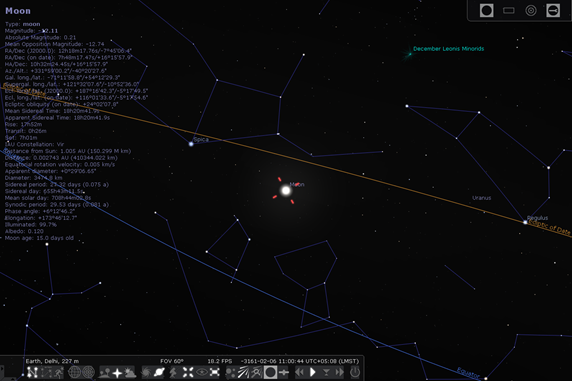
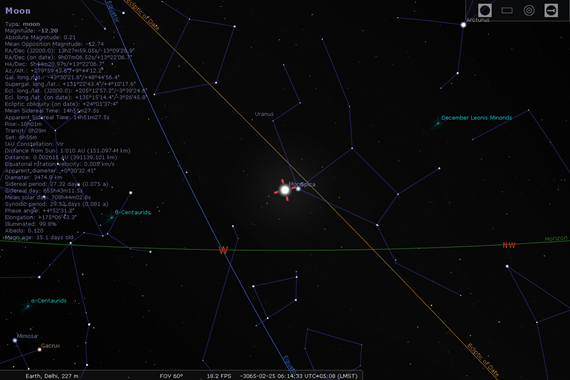
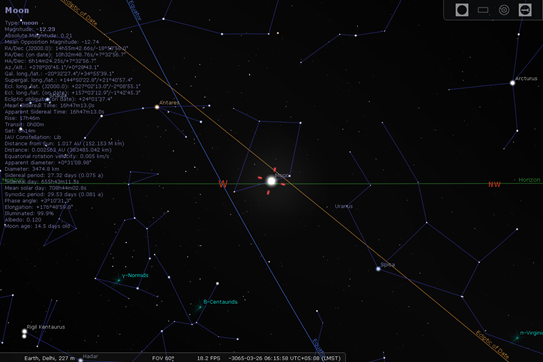
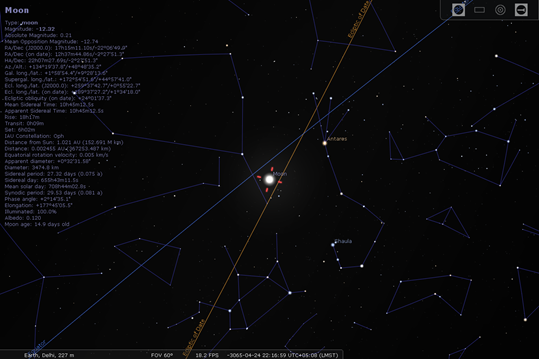
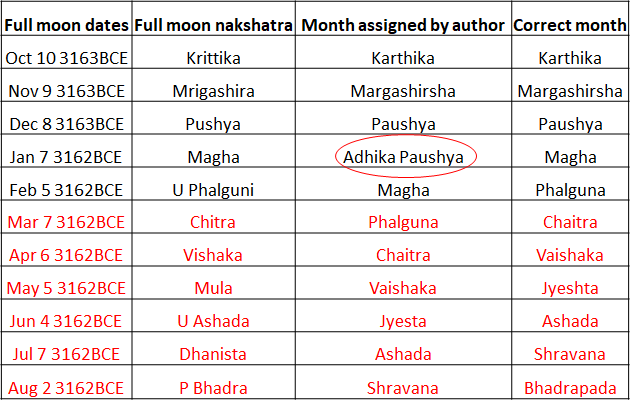
1. Bhishma nirvana in Phalguna wrongly claimed as Magha: In the table 1, all the dates for full moon in the year 3163BCE and 3162BCE are listed. The month assigned by the author is listed along with the actual position of the full moon. It clearly matches till the month of Pushya Dec 8 3163BCE. The author then wrongly introduces an Adhika masa to claim full moon at Magha as Pushya to fit his date of Bhishma nirvana Jan 29 3163BCE in the Magha month. This error propagates to the rest of the months. Chaitra month is wrongly declared as Phalguna, Vaishaka is wrongly declared as Chaitra and so on. Figures 1 to 3 are the sky maps of the full moon days in 3163BCE highlighting the error.

Table 1: Mislabeling Magha month as Adhika Pushya

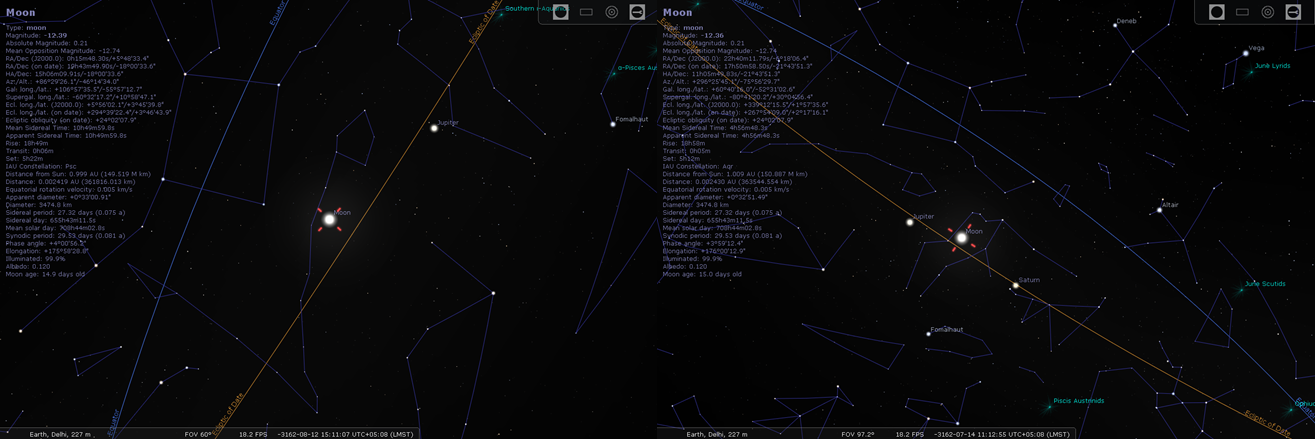
Figure 4 and 5 show that the year 3163BCE had adhika masa in Bhadrapada with a full moon at Purva Bhadra and Uttara Bhadra on July 14 and Aug 12 respectively. It seems the author is introducing two adhika masa in the year 3163 (one in Bhadrapada and one in Pushya) to fit his date of Bhishma nirvana at Magha. This would not be permissible. If either Bhadrapada adhika masa is picked or Pushya adhika masa is picked Bhishma nirvana will fall in the month of Phalguna and not in Magha.

     Figure 1: Full moon Jan 7 3162BCE in Magha is wrongly declared as Pushya Figure 2: Full moon Feb6 3162BCE in U Phalguni is wrongly declared as Magha

Figure 3: Full moon Mar 7 3162BCE in Chitra is wrongly declared as Phaluguna month

Figure 4 and 5: Full moon Aug 12 and July 14 at U Bhadra and P Bhadra.

2. Sri Balarama’s pilgrimage: The date 3163BCE does not accommodate the evidence from Sri Balarama’s pilgrimage. The author inverts the evidence and suggests Sri Balarama left in Shravana and arrived to witness Gadha yudha in Pushya. This puts the date of Sri Balarama’s pilgrimage at October 1 3163BCE. This contradicts the author’s date of October 8 as the date when Sri Krishna left for a peace mission to Hastinapura. Sri Balarama could not have left for pilgrimage even before the peace mission started,

3. Krishna Paksha on Day 13 of war: In 3163BCE the day 13 of war falls in Shukla paksha this contradicts the evidence in verse 7-187-1/2. It clearly states that sun rose when moon was still in the sky implying Krishna Paksha

त्रिभागमात्रेषायां रात्र्यां युद्धमवर्तत।कुरूणां पाण्डवानां च संहृष्टानां विशाम्पते॥ 7-187-1

अथ चन्द्रप्रभां मुष्णन्नादित्यस्य पुरःसरः। अरुणोऽभ्युदयाञ्चक्रे ताम्रीकृर्वन्निवाम्बरम्॥ 7-187-2

Critique of 3067BCE for Mahabharata war date


Critique of 3067BCE date:


Following are the list of major flaws in the year 3067BC
1. Bhishma nirvana in Phalguna wrongly claimed as Magha: In the table 1, all the dates for full moon in the year 3067BCE and 3066BCE are listed. The month assigned by the author of 3067BCE is listed along with the actual position of the full moon. It clearly matches till the month of Magha Dec 27 3067BCE. The author then wrongly introduces an Adhika masa to claim full moon in Purva Phalguni as Magha instead of Phalguna to fit his date of Bhishma nirvana Jan 17 3066BCE. This error then propagates down to the future months. Chaitra month is wrongly declared as Phalguna, Vaishaka is wrongly declared as Chaitra and so on. Figures 1 to 4 are the sky map of the full moon days in 3066BCE highlighting the error.


Table 3: Mislabeling of Phalguna month as Adhika Magha

Figure 1: Full moon Jan 26 3066BCE in Purva Phalguni is wrongly declared as Magha

Figure 2: Full moon Feb 25 3066BCE in Chitra wrongly declared as Phalguna


Figure 3: Full moon March 26 3066BCE in Vishaka is wrongly declared as Chaitra

Figure 4: Full moon April 24 3066BCE in Jyestha is wrongly declared as Vaishaka

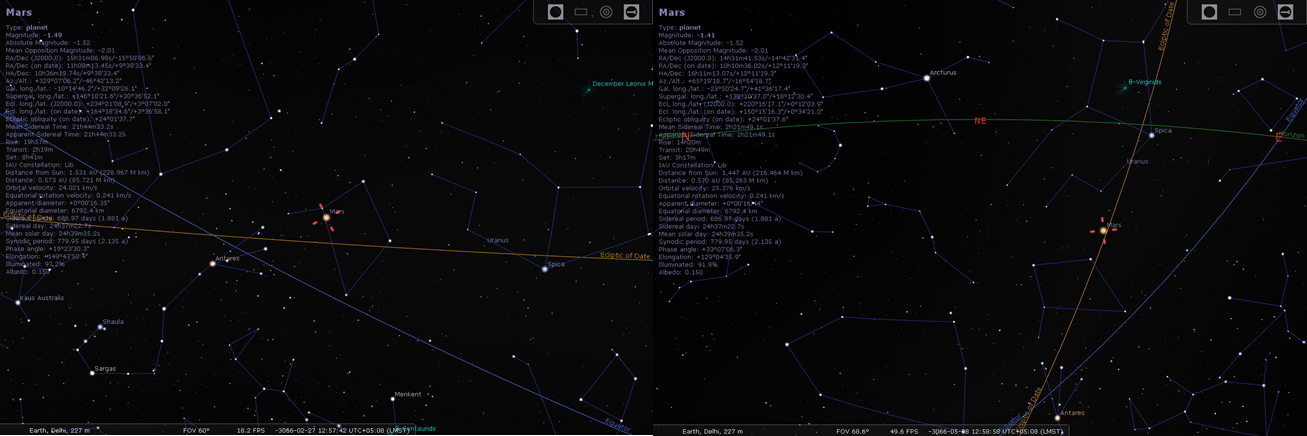
2. Retrograde from Vishaka to Swati is wrongly claimed as retrograde from Jyestha to Anuradha: The verse 5-143-9 from Udyoga parva clearly states that Mars retrogrades from Jyeshta to Anuradha. Sky map of the year 3066BCE in fact shows Mars retrograding from Vishaka to Swati (Figure 5 and 6). Clearly the author of 3066BCE is in error.

कृत्वा चाङ्गारको वक्रं ज्योष्ठायां मधुसूदन। अनुराधां प्रार्थयते मैत्रं संगमयन्निव । 5-143-9

Figure 5: Sky map of Feb 27 3067BC shows Mars at Vishaka and May 8 shows Mars at Swathi

3. Bhishma lying on the bed of arrows for 58 days: There is a clear reference from Anushasana parva (13-273-27) where Bhishma claims that he was lying on the bed of arrows for 58 days.

अष्टपञ्चाशतं रात्र्यः शयानस्याद्य मे गताः। शरेषु निशिताग्नेषु यथा वर्षशतं तथा॥ 13-273-27

As per 3066BCE chronology Bhishma spent only 44 days in the bed of arrows.

4. A month gap between Duryodhana declaring war and Pandavas deciding to go to war: As per 3067BCE chronology Duryodhana declares war on Oct 5 3067BC. Sri Krishna rides with Karna to Upaplavya on Oct 8. He tells Karna to start the war rituals on Oct 15 as per verse 5-142-18. He then has a long deliberation with Pandavas weather to go to war until Nov 1 3067BCE while the enemy is preparing for war. Is the author trying to suggest that Sri Krishna skipped the Oct 15 Amavasya date that he himself set?

सप्तमाच्चापि दिवसादमावास्या भविष्यति। सङ्ग्रामो युज्यतां तस्यां तामाहुः शक्रदेवताम् ॥ 5-142-18

The chronology only fits if we assume only 1 or 2 day passed between Duryodhana declaring war when Pushya is in ascendent, Sri Krishna riding with Karna reaches Upaplavya and convinces Pandavas to head to Kurukshetra immediately.

5. Autumnal equinox in Mrigashira month: As per 3066BCE chronology Autumnal equinox falls on Oct 17 in Mrigashira month. But the verse in Udyoga parva states that Sharad ritu was giving away to Hemant ritu when Sri Krishna left for Hastinapura from Upaplavya in Karthika. The date as per 3067BCE chronology is Sep 27. This is 20 days before the Autumnal equinox. It is not possible for Autumn to end so early.

6. No retrograde motion of Venus in 3067BCE: The verse 6-3-15 mentions Venus retrograding between Uttara Bhadra and Purva Bhandra. There is no such event happening in 3067BCE

शुक्रः प्रोष्ठपदे पूर्वे समारुह्य विरोचते । उत्तरे तु परिक्रम्य सहितः समुदीक्षते ॥ 6-3-15

Criticism of the date 1504BCE and their explanation

 1. Saturn at Rohini vs Ardra: One of the criticisms of the date 1504BCE is that Saturn was at Ardra when the war began and not at Rohini as claimed in the paper.

It is true that Saturn had transitioned to Ardra during the war for 1504BCE. It still was at Rohini and had not transitioned to Ardra when Mars began its retrograde motion earlier in the year. Mahabharata verses 5-143-8/9 mention Saturn at Rohini and Mars retrograding from Jyeshta to Anuradha as a pair. It does not indicate that this happened just before the war. In Fact it is not possible for Mars to retrograde at Jyeshta before war since a solar eclipse happens near Jyeshta before the war. The verse 6-3-18 in fact refers to Mars at Brahmarashi (after retrograding) just before the war.

प्राजापत्यं हि नक्षत्रं ग्रहस्तीक्ष्णो महाद्युतिः । शनैश्चरः पीडयति पीडयन्प्राणिनोऽधिकम् ॥ 5-143-8

कृत्वा चाङ्गारको वक्रं ज्योष्ठायां मधुसूदन। अनुराधां प्रार्थयते मैत्रं संगमयन्निव । 5-143-9

वक्रानुवक्रं कृत्वा च श्रवणं पावकप्रभः । ब्रह्मराशिं समावृत्य लोहिताङ्गो व्यवस्थितः ॥ 6-3-18

2. Magha Shukla Ashtami: Another criticism of 1504BCE is the Bhishma nirvana at Krishna Paksha of Magha. The verse provided is the following (Figure 1) from the Gorakhpur Gita press edition of Mahabharata. The verse is from chapter 47 of Shanti parva when Bhishma is lecturing Pandavas from his bed of arrows. The verse simply describes the state of mind of Bhishma (placing atman in paramatma) before his lecture and not his nirvana. At the end of chapter Pandavas simply return to Hastinapur. In fact Bhishma ends up giving several other lectures in Shanti Parva and passes away at the end of Anushasan Parva. This verse only shows that Bhishma lived several days after Magha Shukla Ashtami Rohini nakshatra.

Figure 1: Vaishampanaya describing the day when Bhishma is lecturing Pandavas[2]

3. Day 13 war: Another criticism of 1504BCE is that day 13 of the war as per 1504BCE is not Krishna paksha and is in fact Amavasya.

This criticism is incorrect. The day 16 of war in 1504BCE is the Mrigashirsha Amavasya day. Day 13 is still Krishna Paksha with moon rise few hours before sun rise as described the verse 7-187-1/2

त्रिभागमात्रेषायां रात्र्यां युद्धमवर्तत।कुरूणां पाण्डवानां च संहृष्टानां विशाम्पते॥ 7-187-1

अथ चन्द्रप्रभां मुष्णन्नादित्यस्य पुरःसरः। अरुणोऽभ्युदयाञ्चक्रे ताम्रीकृर्वन्निवाम्बरम्॥ 7-187-2

Translation: When three-fourths of that night had worn away, the battle, O king, once more commenced between the Kurus and the Pandavas. Both sides were elated with joy. Soon after, Aruna, the charioteer of Surya, weakening the splendour of the moon, appeared, causing the welkin to assume a coppery hue. 


Resolving the internal contradictions in Mahabharata astronomical data

Let us look into the the astronomical references that apparently contradict with one another. They contradict not just for the year 1504BCE but for any other year. This section uses the three assumptions listed to explain and resolve these apparent contradictions.

Assumption 1: Observation > Prediction: References that are observations of past events must be chosen when it contradicts references that are a prediction of the future events.  It is not unreasonable to assume that ancients did not have the right mathematical tools to make accurate predictions.

1. Bhishma nirvana 56 days after war has ended vs 58 days from day 10 of the war: There are two verses in Mahabharata referring to Bhishma nirvana from Mahabharata which appear contradictory. The first verse (12-50-14) is from Shanti parva. Here Sri Krishna makes a prediction to Bhishma sometime after the war has ended. He says that Bhishma has 56 days left on earth.

पञ्चाशतं षट् च कुरुप्रवीर शेषं दिनानां तव जीवितस्य। ततः शुभैः कर्मफलोदयैस्त्वं समेष्यसे भीष्म विमुच्य देहम्॥ 12-50-14 [1]

The second verse is from Anushasana Parva (13-273-27). Here Bhishma makes an observation that he was lying on the bed of arrows for 58 days.

अष्टपञ्चाशतं रात्र्यः शयानस्याद्य मे गताः। शरेषु निशिताग्नेषु यथा वर्षशतं तथा॥ 13-273-27

The two verses at the face value appear contradictory. As per 13-272-27 verse, 58 days elapsed from day 10 of the war till the day Bhishma passed away. Then it must be day 12 of the war when 56 days are left for Bhishma to die as per verse 12-50-14. But the verse 12-50-14 is from Shanti parva which occurs after war has ended.

If we assume that ancients could not predict future astronomical events such as winter solstice accurately then this contradiction is resolved. Sri Krishna is making an observation of the future event but Bhishma is recording an event that has passed. So we should accept the verse 13-273-27 and explain the verse 12-50-14 as a wrong prediction. This applies not just to 1504BCE but to any year.

2. Karthika month Amavasya seven days from Pushya vs Amavasya at Jyeshta: There are several verses in the Mahabharata which refer to the position of moon at Pushya when both parties decide to go for war. Verse 5-150-3 describes Sri Krishna paraphrasing Duryodhana who observes moon ascending into Pushya while he announces his intention to march to Kurukshetra. The verse 9-35-11 describes Sri Krishna at Upaplavya leaving with Pandavas for war to Kurukshetra. The verse 9-35-16 in addition also mentions Sri Balarama leaving for the pilgrimage on Pushya while Pandavas head to war. The inference would be that Sri Krishna left Hastinapur after a failed peace mission when Pushya was in the ascendant. He then met Pandavas at Upaplavya. He then recounts the events of Hastinapur and leaves for war while the moon is still in Pushya.

आज्ञापयच्च राज्ञस्तान्पार्थिवान्नष्टचेतसः । प्रयात वै कुरुक्षेत्रं पुष्योऽद्येति पुनः पुनः ॥ 5-150-3

न कुर्वन्ति वचो मह्यं कुरवः कालनोदिताः। निर्गच्छध्व पाण्डवेयाः पुष्येण सहिता मया॥ 9-35-11

रौहिणेये गते शूरे पुष्येण मधुसूदनः। पाण्डवेयान्पुरस्कृत्य ययावभिमुखः कूरून्॥ 9-35-16

चत्वारिंशदहान्यद्य द्वे च मे निःसृतस्य वै। पुष्येण सम्प्रयातोऽस्मि श्रवणे पुनरागतः। शिष्ययोर्वै गदायुद्धं द्रुष्टुकामोऽस्मि माधव॥ 9-16-6

There is another verse in Udyoga parva where Karna offers a quick ride back to Upaplavya to Sri Krishna. In this verse (5-142-18) Sri Krishna predicts that in seven days Amavasya is in Jyeshta.

सप्तमाच्चापि दिवसादमावास्या भविष्यति। सङ्ग्रामो युज्यतां तस्यां तामाहुः शक्रदेवताम् ॥ 5-142-18

The set of verses (5-150-3,9-35-11,9-35-16) conflict with verse 5-142-18. In seven days the moon at Pushya can only travel to Vishaka. It is not possible for the moon to be at Jyestha. Since the events are happening in Karthika month, the new moon usually falls at Anuradha/Jyeshta. But occasionally the full moon can be at Bharani instead of Krittika and the new moon at Vishaka. Hence it is possible that 5-142-18 can be a wrong prediction as per assumption 1. The verses 5-150-3, 9-35-11 and 9-35-16 are observations of a past event. Hence we should assume them to be true.

There are some arguments which give a gap of 1 month between Duryodhana declaring war on Pushya in Karthika month and Sri Krishna leaving with Pandavas to war in Mrigashira Pushya[3]. This explanation allows the event of Sri Krishna with Karna anywhere in this period of 1 month and thus reconciles these apparent contradictory evidences. There is a flaw in this proposition. It assumes that Kauravas started preparing for war while Pandavas are still deliberating whether to go to war for a month. This would be a very bad war strategy. Sri Krishna tells Karna to start preparation for the war in 7 days in Amavasya. But this explanation contradicts Sri Krishna’s own words. It shows Sri Krishna and Pandavas did not start the war ritual in Amavasya but were still deciding whether to go to  war for another 3 weeks..

Assumption 2: Multiple planetary position refer to past event

1. Saturn at Rohini vs Saturn in UttaraPhalguni: The verse 5-143-8 and 6-2-32 refer to Saturn at Rohini during the year of the Mahabharata war.

प्राजापत्यं हि नक्षत्रं ग्रहस्तीक्ष्णो महाद्युतिः । शनैश्चरः पीडयति पीडयन्प्राणिनोऽधिकम् ॥ 5-143-8

रोहिणीं पीडयन्नेष स्थितो राजञ्शनैश्चरः । व्यावृत्तं लक्ष्म सोमस्य भविष्यति महद्भयम् ॥ 6-2-32

The set of verse 6-3-14 and 6-3-15 refer to Saturn at Uttara Phalguni. Since Saturn moves from one nakshatra to the next in one year both these verses cannot be simultaneously true.

If we assume that only one refers to the year of the Mahabharata the other must refer to an event in Past. In the year 1504BCE Saturn is at Rohini. Then Saturn at Uttara Phalguni refers to the year 1526 BCE.

The set of verses 6-3-14/15 provides not only the position of Saturn but also the position of Mars, Jupitar and Venus. In the following section we will see that it lines up well for the year 1526BCE. 

मघास्वङ्गारको वक्रः श्रवणे च बृहस्पतिः । भगं नक्षत्रमाक्रम्य सूर्यपुत्रेण पीड्यते ॥ 6-3-14

शुक्रः प्रोष्ठपदे पूर्वे समारुह्य विरोचते । उत्तरे तु परिक्रम्य सहितः समुदीक्षते ॥ 6-3-15

2. Mars retrograde at Jyeshta vs Mars retrograde at Magha: The verse 5-142-9 refers to Mars retrograding from Jyestha to Anuradha. The set of verses 6-3-14/15 refers to mars retrograding at Magha. For the year 1504BCE Mars is retrograding from Jyeshta to Anuradha while in 1526BCE (Saturn at Uttara Phalguni) Mars is retrograding at Magha. The multiple positions of mars reconciles very well with the multiple positions of Saturn.

कृत्वा चाङ्गारको वक्रं ज्योष्ठायां मधुसूदन। अनुराधां प्रार्थयते मैत्रं संगमयन्निव । 5-143-9

3. Jupitar retrograde in Shravana and Venus retrograde at Purva Bhadrapada: The set of verse 6-3-14/15 not only mentions Saturn at Uttara Phalguni and Mars retrograding at Magha, but also Jupiter retrograding at Shravana and Venus retrograding at Purva Bhadrapada. It can shown to be true in the year 1526BCE.

Assumption 3: Alternate interpretation of one-off references that causes internal contradiction

1. Jupitar and Saturn at Vishaka for 1 year: The verse 6-3-27 refers to Saturn and Jupitar  at Vishaka for 1 year. This is not possible since Jupitar moves 2 nakshatras in 1 year. Hence we need to seek alternate meaning for the term Vishaka. The original meaning of Vishaka is fork/divide. We can interpret Vishaka as the horizon since it is the place where heaven and earth fork/divide. It turns out that for the year 1504BCE, Jupitar and Saturn are at the opposite ends of the horizon for 1 year.

संवत्सरस्थायिनौ च ग्रहौ प्रज्वलितावुभौ । विशाखयोः समीपस्थौ बृहस्पतिशनैश्चरौ ॥ 6-3-27

2. Bhishma nirvana 58 days from day 10 of war vs Magha Shukla paksha: The set of verses 13-273-26/27/28 refer to Bhishma describing the day of his nirvana. The set of verses starts with Bhishma’s observation that the sun has started its northwards course. It also refers to Bhishma lying on the bed of arrows for 58 days (from day 10 of the war). The final verse is interpreted as Magha Shukla Ashtami while it simply states that only a third of a month is left and is on the bright side.

The observation that Bhishma has been on the bed of arrows for 58 days contradicts Magha Shukla Ashtami. During Magha Shukla Ashtami moon is near Rohini nakshatra. But in verse 9-16-6 Sri Balarama says that he has returned on the day of Sravana nakshatra to witness Gaddha yudh on Day 19. Assuming moon travels 1 nakshatra per day on average, Moon at Sravana on Day 19 and 58 days from day 10 of war points to moon at Vishaka (Magha Krishna Ashtami) during Bhishma nirvana.

Any attempt at placing Bhishma nirvana at Magha Shukla Ashtami Rohini nakshatra will have to contradict with either Balarama witnessing Gadha yudh on Sravana or Bhishma lying on the bed of arrows for 58 days.

Since the verse itself mentions only a third of the month is left it points to Krishna paksha only. This reconciles the evidence that Bhishma was lying on the bed of arrows for 58 days and Balarama arriving on the day of Sravana to witness the Gadha yudh. The word bright side of the month in the verse can be reinterpreted as the portion of Magha month that falls in Uttarayan.

दिष्ट्या प्राप्तोसि कौन्तेय सहामात्यो युधिष्ठिर। परिवृत्तो हि भगवान्सहस्रांशुर्दिवाकरः॥ 13-273-26 (92305) अष्टपञ्चाशतं रात्र्यः शयानस्याद्य मे गताः। शरेषु निशिताग्नेषु यथा वर्षशतं तथा॥ 13-273-27 (92306) माघोऽयं समनुप्राप्तो मासः पुण्यो युधिष्ठिर। त्रिभागशेषः पक्षोऽयं शुक्लो भवितुमर्हति॥ 13-273-28


Wednesday, December 25, 2019

Drona Nirvana and the 18 days of Mahabharata war


Today Mrigashira Krishna Chaturdashi would mark the day for Drona nirvana. This blog attempts to present the evidence supporting it.

Balarama's pilgrimage and 19th day of the war
In the previous blogs I had mentioned that the 18 days of the Mahabharata do not provide any absolute position of the moon or the sun. The only absolute evidence come from the Balarama's pilgrimage. As shown in the verse evidence 0, Balarama arrives on the day of Shravana to witness the duel between his two disciples on the day 19 of the war. He also states that he left for the pilgrimage 42 days before on the day of Pushya. We will use this to date the 18 days of the war

Evidence 0 Day 19 of war Balarama returns to witness Bhima-Duryodhana fight Nov 15
चत्वारिंशदहान्यद्य द्वे च मे निःसृतस्य वै। पुष्येण सम्प्रयातोऽस्मि श्रवणे पुनरागतः। शिष्ययोर्वै गदायुद्धं द्रुष्टुकामोऽस्मि माधव॥ 9-34-6
Translation: Two and forty days have passed since I left home. I had set out under the constellation Pushya and have come back under Shravana. I am desirous, O Madhava, of beholding this encounter with the mace between these two disciples of mine


18 days of the Mahabharata war from Balarama's pilgrimage evidence
From Udyoga parva, we know that Balarama's pilgrimage started in the Karthika month at Pushya Nakshatra. Hence the 42nd day of Shravana will fall in the Pushya month, assuming roughly 1 Nakshatra per day. Since Shravana falls on the 19th day of war, the position of the moon for the 18 preceding days will be:

Day 1: Rohini
Day 2: Mrigashira (Mrigashira Pournima)
Day 3: Ardra
Day 4: Punarvasu
Day 5: Pushya
Day 6: Aslesha
Day 7: Magha
Day 8:  Purva Phalguni
Day 9: Uttara Phalguni
Day 10: Hasta
Day 11: Chitra
Day 12: Swathi
Day 13: Vishaka
Day 14: Anuradha
Day 15: Jyeshta
Day 16: Mula  (Mrigashira Amavasya)
Day 17: Purva Ashada
Day 18: Uttara Ashada 
Day 19: Shravana 

Now let us map the above days to 1504BCE and the verses marking the end of each day of the war. The war parva (Bhishma, Drona, Karna and Shalya) describe every day's end of the war with a sunset except day 14 and 15. These verses marking the end of the day are listed below in verse evidence 1 to 18.

Evidence 1: First day of war ends on Oct 28th 1504B.C
ततः सैन्येषु भग्नेषु मथितेषु च सर्वशः । प्राप्ते चास्तं दिनकरे न प्राज्ञायत किंचन ॥ 6-49-52
Translation: And then when the troops of the Pandavas were routed and crushed all over the field, the sun set and nothing could be seen.

Evidence 2: Second day of war ends on October 29th 1504B.C
ततोऽवहारः सैन्यानां तव तेषां च भारत। अस्तं गच्छति सूर्येऽभूत्सन्ध्याकाले च वर्तति ॥ 6-55-45
Translation: Yon Sun, robbing in every way the vision of the whole world, is about to reach that best of mountains called Asta

Evidence 3: Third day of war ends on October 30th 1504B.C
विनेदतुस्तावतिहर्षयुक्तौ गाण्डीवधन्वा च जनार्दनश्च। ततो रविं संवृतरश्मिजालं दृष्ट्वा भृशं शस्त्रपरिक्षताङ्गाः ॥ 6-59-132
Translation: And that foremost of men, Dhananjaya also, having achieved a great feat and won great renown by crushing his foes, and beholding the sun assume a red hue and the evening twilight to set in, and having completed his work, retired with his uterine brothers to the camp for nightly rest

Evidence 4: Fourth day of the war ends on October 31st 1504B.C
इदानीं युधि निर्जेतुं न शक्योऽसौ स राक्षसः । अस्तमभ्येति सविता रात्रौ योद्धुं कन शक्यते। अवहारमतः कुर्मः श्वो योत्स्यामः परै सह ॥ 6-64-78
Translation: I do not like fresh encounter with the victorious Pandavas. Let the withdrawal of our army, therefore, be proclaimed today. Tomorrow we will fight with the foe

Evidence 5: Fifth day of the war ends on November 1st 1504B.C
अवहारं ततश्चक्रे पिता देवव्रतस्तव । संध्याकाले महाराज सैन्यानां श्रान्तवाहनः ॥ 6-74-38
Translation: Then at twilight, O king, thy sire Devavrata, his animals having been tired, caused the troops to be withdrawn.

Evidence 6: Sixth day of the war ends on November 2nd 1504B.C
अन्योन्यागस्कृतां राजन्यमराष्ट्रविवर्धनम् । मुहूर्तास्तमिते सूर्ये चक्रुर्युद्धं सुदारुणम् ॥ 6-79-61
Translation: Cherishing feelings of hostility towards one another, the terrible battle in which they took part lasted for a short space of time about sunset, increasing the population of Yama's kingdom

Evidence 7: Seventh day of war ends on November 3rd 1504B.C
एवमेते महाराज तावकाः पाण्डवैः सह। पर्यवर्तन्त सहिता निशाकाले परंतप ॥ 6-86-52
Translation: And the lord Yudhishthira also of Kuru's race, accompanied by his brothers, and followed by his troops, proceeded, O king, when night set in, towards his tent.

Evidence 8: 8th day of the war ends on November 4th 1504B.C
अवहारं ततः कृत्वा सहिताः कुरुपाणड्वाः । न्यविशन्त निशाकाले गत्वा स्वशिबिरं तदा ॥6-96-80
Translation: Thereupon both the Kurus and the Pandavas withdrew their armies, when that awful night of pitchy darkness came.

Evidence 9: 9th day of war ends on November 5th 1504B.C
युध्यतामेव तेषां तु भास्करेऽस्तमुपागते। सन्ध्या समभवद्धोरा नापश्याम ततो रणम् ॥ 6-107-1
Translation: While they were battling, the Sun set, O Bharata, aid there came the dreadful hour of twilight and the battle could no longer be seen.

Evidence 10: 10th day of war ends on November 6th 1504B.C
सायाह्ने न्यपतद्भूमौ धार्तराष्ट्रान्विषादयन् ॥ 6-120-7x
Translation: Slain in the evening the Kuru grandsire Bhishma saddened the Dhartarashtras and delighted the Panchalas

Evidence 11: 11th day of war ends on November 7th . Dronabishekam
दिवाकरेऽस्तंगिरिमास्थिते शनै रुभे प्रयाते शिबिराय भारत॥ ॥ 7-32-80
Translation: Meanwhile, the Sun went to his chambers in the western hills, and both the armies, O Bharata, slowly retired to their respective tents.

Evidence 12: 12th day of war ends on November 8th . Abhimanyu’s death.
श्वोभूते किमकार्षुस्ते दुःखशोकसमन्विताः। अभिमन्यौ हते तत्र कैर्वाऽयुध्यन्त पाण्डवाः॥ 7-85-1
Translation: 'After Abhimanyu's slaughter when the next day came, what did the Pandavas, afflicted with grief and sorrow do?

Evidence 13: 13th day of war ends on November 9th . Jayadratha’s death.
अस्तमेति महाबाहो त्वरमाणो दिवाकरः॥ 7-145-4
Translation:  The sun is about to set at the mountain of Asta.

Evidence 14: 14th day of war happens all night. A brief halt just before moon rise before sun rise
यथा चन्द्रोदयोद्धूतः क्षुभितः सागरोऽभवत्। तथा चन्द्रोदयोद्धूतः क्षुभितश्च बलार्णवः॥ 7-185-56  ततः प्रववृते युद्धं पुनरेव विशाम्पते। लोके लोकविनाशाय परं लोकमभीप्सताम्॥ ॥ 7-185-57
Translation: Indeed, that sea of troops was awakened by the rays of the moon bloomed (into life) like an assemblage of lotuses expanded by the rays of the sun. Indeed, that sea of troops was awakened by the risen moon like the ocean swelling up in agitated surges at the rise of that luminary. Then, O king, the battle once more commenced on earth, for the destruction of the earth's population, between men that desired to attain to heaven

Evidence 15: The sun rise on Day 15 of war while moon is present. November 11th
अथ चन्द्रप्रभां मुष्णन्नादित्यस्य पुरःसरः। अरुणोऽभ्युदयाञ्चक्रे ताम्रीकृर्वन्निवाम्बरम्॥ 7-187-2
Translation: Soon after, Aruna, the charioteer of Surya, weakening the splendour of the moon, appeared, causing the welkin to assume a coppery hue.

Evidence 16: 16th day of war sun sets. November 12th
ततः कृतेऽवहारे च प्रहृष्टास्तत्र पाण्डवाः। निशायां शिबिरं गत्वा न्यवसन्त नरेश्वराः॥ 8-21-43
Translation: The withdrawal having been made, those sinless men, the Pandavas, became very glad, and proceeding to their tents rested there for the night.

Evidence 17: 17th day of war sun sets. Mercury is visible at sun set. November 13th
हते च कर्णे सरितो न सस्रु-- र्जगाम चास्तं कलुषो दिवाकरः। श्वेतो ग्रहश्च ज्वलितार्कवर्णो यमस्य पुत्रोऽभ्युदितः स तिर्यक्॥ 8-100-15
Translation: When Karna fell, the rivers stood still. The Sun set with a pale hue. The planet Mercury, the son of Soma, assuming the hue of fire or the Sun, appeared to course through the firmament in a slanting direction.

Evidence 23: Day 18 of war November 14 1504B.C Yuyutsu at sun set returns to Hastinapura
तैश्चैव सहितः क्षिप्रमस्तं गच्छति भास्करे। प्रविष्टो हास्तिनपुरं बाष्पकण्ठोऽश्रुलोचनः॥ 9-29-76
Translation: The sun was setting. With those ladies, Yuyutsu entered the city of Hastinapura, with tearful eyes and with voice choked in grief.

Drona Nirvana:
On the day 14 and 15 of the war, unlike other days did not end with the sunset. The war extends all through the night ending with Drona nirvana on day 15. Interestingly, as described in the verse evidence 14 and 15, the moon rise happens just before the sunrise. This indicates that the day 14 and day 15 happens just before Amavasya. This perfectly aligns with our predicted map of the war days with respect to Balarama's pilgrimage evidence which predicts Amavasya on Day 16.

For the year 1504B.C.E, day 15, Drona nirvana day, falls on November 11th Magha Krishna Chaturdashi.

Sunday, December 22, 2019

Balarama's pilgrimage and Bhishma Nirvana: The strongest evidence for dating Mahabharata to 1504BCE

Introduction:

Today, on the day of winter solstice 2019, I would like to discuss the most crucial piece of evidence backing 1504BCE for the mahabharata war.: Balarama's pilgrimage and Bhishma nirvana

In the previous blogs we have seen that four pieces of evidence are necessary and sufficient to date the Mahabharata war to 1504 BCE. The first three of the evidences(Winter solstice at Magha month, position of Saturn and retrograde of mars) narrows us to few possibilities. But the final piece that seals the year 1504BCE, is the solar eclipse at the end of Karthika month. Specifically the seven day interval between moon at Pushya in the Karthika month and the solar eclipse.  Though these are sufficient to narrow the date, there is another crucial piece that seals the evidence in favor of 1504BCE. It is alignment of Balarama's pilgrimage and Bhishma nirvana.

Balarama's pilgrimage starts on Karthika month Pushya nakshatra. The pilgrimage ends on the 42nd day which coincides with the 19th day of war (Duryodhana's demise). The Bhishma nirvana evidence states that Bhishma has been lying on the bed of arrows for 58 days since the day 10 of the war. Hence there are (58+42-9) 91 days between moon at Pushya in Karthika month to Bhishma nirvana. For the year 1504 BCE, adding 91 days to Karthika month Pushya day (October 5th 1504BCE in Figure1) brings us to Jan 3 1503BCE. The day is exactly the day after the winter solstice(Jan 2 1503BCE in figure2)! This is the strongest evidence for 1504 BCE.


Figure 1: Moon at Pushya on Oct 5th 1504BCE


Figure 2: Winter solstice Jan 2nd 1503BCE


Balarama's pilgrimage: A quick summary

The 42 day pilgrimage of Balarama is stated in the verse evidence 1, 2 and 3.

The verse evidence 1 tells us that Balarama left for pilgrimage when moon was at Pushya from Upaplavya (Pandava's camp). The verse evidence 2 clarifies that he starts his pilgrimage when moon reaches Mitra or Anuradha star. Balarama took as many days as between Pushya and Anuradha to travel from Upaplavya (Pandava's camp) to his hometown Dwaraka. The pilgrimage actually starts from Dwaraka.

In the verse evidence 3 Balarama states that he was absent for 42 days. He has come to Kuruskshetra on the day moon is in Shravana. Mapping the moon location in Pushya, Anuradha and Shavana gives us the dates October 5th, October 14th and November 15th. There are 42 days between October 5th and November 15th.


Evidence 1:Balarama decides not to fight war and leaves under the star Pushya. October 5th
न कुर्वन्ति वचो मह्यं कुरवः कालनोदिताः। निर्गच्छध्व पाण्डवेयाः पुष्येण सहिता मया॥ 9-35-11
रौहिणेये गते शूरे पुष्येण मधुसूदनः। पाण्डवेयान्पुरस्कृत्य ययावभिमुखः कूरून्॥ 9-35-16
Translation: 'Urged by Fate, the Kauravas are for disregarding my words! Come, ye sons of Pandu, with me (to the field of battle), setting out under the constellation Pushya!'  (Said Krishna). After the heroic son of Rohini had set out under the constellation Pushya, the slayer of Madhu, placing the Pandavas in his van, proceeded against the Kurus.


Evidence 2: Balarama starts his pilgrimage on October 14th
 तीर्थयात्रां हलधरः सरस्वत्यां महायशाः। मैत्रनक्षत्रयोगे स्म सहितः सर्वयादवैः॥ 9-35-14
Translation: The wielder of the plough then set out on a pilgrimage to the Sarasvati. Accompanied by all the Yadavas, he set out under the conjunction of the asterism called Maitra.

Evidence 3: Day 19 of war Balarama returns to witness Bhima-Duryodhana fight Nov 15
चत्वारिंशदहान्यद्य द्वे च मे निःसृतस्य वै। पुष्येण सम्प्रयातोऽस्मि श्रवणे पुनरागतः। शिष्ययोर्वै गदायुद्धं द्रुष्टुकामोऽस्मि माधव॥ 9-34-6

Translation: Two and forty days have passed since I left home. I had set out under the constellation Pushya and have come back under Shravana. I am desirous, O Madhava, of beholding this encounter with the mace between these two disciples of mine

Balarama's pilrimage in detail

The Shalya parva gives an exhaustive list of pilgrimage sites Balarama visited during his pilgrimage. As stated before, Balarama's pilgrimage was between October 14 to November 15. There 32 days in between. It turns out the number of sites visited by Balarama is also 32. By assigning a day to each site we can map out his pilgrimage as given below.

Pilgrimage site 1: Prabhasa-October 15
ऋत्विक्सुहृद्विप्रगणैश्च सार्धम्। पुण्यं प्रभासं समुपाजगाम यत्रोडुराढ्यक्ष्मणा क्षीयमाणः॥ 9-35-42 Translation: Accompanied by his priests and friends, Valadeva first proceeded to the tirtha called Prabhasa. There, the Lord of the constellations (Soma), who had been affected with phthisis, became freed from his curse.

Pilgrimage site 2: Chamasodbheda-October 16
ततस्तु चमसोद्भेदमभीतस्त्वगमद्बली। चमसोद्भेद इत्येवं यं जनाः कथयन्त्युत॥ 9-36-44 Translation: After this, the mighty Baladeva of un-decaying glory proceeded to Chamasodbheda, that is, to that tirtha which is called by that name.

Pilgrimage site 3: Udapana-October 17
उदपानमथागच्छत्त्वरावान्केशवाग्रजः। आद्यं स्वस्त्ययनं चैव तत्रावाप्य महाबलः॥ 9-36-46 Translation: The elder brother of Keshava then proceeded quickly to Udapana. Although the Sarasvati seems to be lost there

Pilgrimage site 4: Vinasana-October 18
उदपानं च तं वीक्ष्य प्रशस्य च पुनःपुनः। नदीगतमदीनात्मा प्राप्तो विनशनं तदा॥ ॥ 9-37-53 Translation: Beholding Udapana and applauding it repeatedly, Valadeva next proceeded to Vinasana which also was on the Sarasvati.

Pilgrimage site 5: Subhumika-October 19
तत्राप्युपस्पृश्य बलः सरस्वत्यां महाबलः। सुभूमिकं ततोऽगच्छत्सरस्वत्यास्तटे वरे॥ 9-38-2 Translation: Having bathed in that tirtha of the Sarasvati, the mighty Baladeva then proceeded to Subhumika, situated on the excellent bank of the same river.

Pilgrimage site 6: Tirtha of Gandharvas-October 20
शय्याश्च विपुला दृष्ट्वा देवगन्धर्वरक्षसाम्। गन्धर्वाणां ततस्तीर्थमागच्छद्रोहिणीसुतः॥ 9-38-9 Translation: He also saw there many shadows of gods, Gandharvas, and Rakshasas. The son of Rohini then proceeded to the tirtha of the Gandharvas.

Pilgrimage site 7: Gargasrota-October 21
तस्माद्गन्धर्वतीर्थाच्च महाबाहुररिन्दमः। गर्गस्रोतो महातीर्थमाजगामैककुण्डली॥ 9-38-13 Translation: Leaving that tirtha resorted to by Gandharvas, that mighty-armed chastiser of foes, having but one earring, then proceeded to the famous tirtha called Gargasrota.

Pilgrimage site 8: Sankha-October 22
उच्चावचांस्तथा भक्ष्यान्विप्रेभ्यो विप्रदाय सः। नीलवासास्तदाऽगच्छच्छङ्घतीर्थं महायशाः॥9-38-19 Translation: Having given also many kinds of costly viands unto the Brahmanas, that illustrious one attired in blue robes then proceeded to the tirtha called Sankha.

Pilgrimage site 9: Dwaita lake - October 23
पूजयित्वा द्विजांश्चैव पूजितश्च तपोधनैः। पुण्यं नैसर्गिकं राजन्नाजगाम हलायुधः॥ 9-38-26 Translation:  He then, O king, proceeded to the Dwaita lake. Arrived there, Vala saw diverse kinds of ascetics in diverse kinds of attire.

Pilgrimage site 10: Tirtha in southern bank -October 24
तथैव दत्त्वा विप्रेभ्यः परिभोगान्सुपुष्कलान्। ततः प्रायाद्बलो राजन्दक्षिणेन सरस्वतीम्॥ 9-38-28 Translation: Having given away unto the Brahmanas diverse articles of enjoyment in profusion, Baladeva then, O king, proceeded along the southern bank of the Sarasvati.

Pilgrimage site 11: Nagadhanwana-October 25
गत्वा चैवं महाबाहुर्नातिदूरे महायशाः। धर्मात्मा नागधन्वानं तीर्थमागमदच्युतः॥ 9-38-29 Translation: The mighty-armed and illustrious Rama of virtuous soul and unfading glory then proceeded to the tirtha called Nagadhanwana.

Pilgrimage site 12: Tirtha where Saraswati changed the course to eastward direction-October 26
ततो रामोऽगमत्तीर्थमृषिभिः सेक्तिं महत्। यत्र भूयो निववृते प्राङ्मुखा वै सरस्वती॥ 9-38-36 Translation: Baladeva once more set out, along the way that those ascetics pointed out to him, for reaching that spot where the Sarasvati turns in an eastward direction, like torrents of rain bent by the action of the wind.

Pilgrimage site 13: Sapta-Saraswat-October 27
सप्तसारस्वतं तीर्थमाजगाम हलायुधः। यत्र मङ्कणकः सिद्धस्तपस्तेपे महामुनिः॥ ॥ 9-38-65 Translation: Valadeva, having the plough for his weapon, arrived at that tirtha called Sapta-Saraswat, where the great ascetic Mankanaka had performed his penances and became crowned with success

Pilgrimage site 14: Kapalamochana-October 28
ततस्त्वौशनसं तीर्थमाजगाम हलायुधः। कपालमोचनं नाम यत्र मुक्तो महामुनिः॥ 9-40-4 Translation: Baladeva then went to the tirtha known by the name of Usanas. It is also called Kapalamochana.

Pilgrimage site 15: Lokaloka-October 29
ससर्ज यत्र भगवाँल्लोकाँल्लोकपितामहः॥ 9-40-35
Translation: Possessed of great might and great prowess Baladeva then proceeded to that tirtha where the adorable Grandsire had created the mountains called Lokaloka.

Pilgrimage site 16: Vaka Dalvya Ashram - October 30
ब्रह्मयोनिभिराकीर्णं जगाम यद्वुनन्दनः। यत्र दाल्भ्यो बको राजन्पश्वर्थ सुमहातपाः। 9-41
Translation: Then, O king, Rama proceeded to the asylum of Vaka which was not very distant from where he was, that asylum in which, as heard by us, Dalvya Vaka had practiced the austerest of penances.

Pilgrimage site 17: Yayata-October 31
रत्नानि च महार्हाणि धनं धान्यं च पुष्कलम्। ययौ तीर्थं महाबाहुर्यायातं पृथिवीपते॥ 9-42-32 Translation: Having with due rites given unto the Brahmanas steeds and elephants and vehicles with mules yoked unto them and jewels of great value and much wealth, and much corn, the illustrious and mighty-armed Rama then proceeded, O king, to the tirtha called Yayata.

Pilgrimage site 18: Vasishthapavaha-November 1
ततस्तालकेतुर्महाधर्मकेतु-- र्महात्मा कृतात्मा महादाननित्यः। वसिष्ठापवाहं महाभीमवेगं धृतात्मा जितात्मा समभ्याजगाम॥ ॥ 9-42-39
 Translation: The illustrious Baladeva, of soul subdued and restrained and cleansed, having the Palmyra on his banner, distinguished by great righteousness, and ever giving away the most valuable things, then proceeded to that tirtha of fierce current called Vasishthapavaha.

Pilgrimage site 19: Soma’s tirtha-November 2
तत्राप्युपस्पृश्य बलो महात्मा दत्त्वा च दानानि पृथग्विधानि। अवाप्य धर्मं परमार्यकर्मा जगाम सोमस्य महत्सुतीर्थम्॥ 9-44-46
 Translation: The high-souled Baladeva having bathed in that tirtha and given away many kinds of gifts, obtained great merit. Of righteous deeds, he then proceeded to the great tirtha of Soma.

Pilgrimage site 20: Agni tirtha-November 3
ततस्त्रत्राप्युपस्पृश्य दत्त्वा च विविधं वसु। अग्नितीर्थं महाप्राज्ञो जगामाथ प्रलम्बहा। नष्टो न दृश्यते यत्र शमीगर्भे दुताशनः॥ 9-48-13
Translation: Bathing in that tirtha also and giving away diverse kinds of gifts, Baladeva, the slayer of Pralamva, possessed of great wisdom, then proceeded to Agnitirtha, that spot where the eater of clarified butter, disappearing from the view, became concealed within the entrails of the Sami wood.

Pilgrimage site 21: Brahmayoni-November 4
तत्राप्य आप्लुत्य मतिमान बरह्मयॊनिं जगाम ह ससर्ज भगवान यत्र सर्वलॊकपितामहः॥ 9-48-23   Translation: The intelligent Balarama, having bathed there, then proceeded to Brahmayoni where the adorable Grandsire of all the worlds had exercised his functions of creations.

Pilgrimage site 22: Kauvera-November 5
तत्र स्नात्वा च दत्त्वा च वसूनि विविधानि च। कौबेरं प्रययौ तीर्थं यत्र तप्त्वा महत्तपः॥9-48-24  Translation: Bathing there and giving away diverse kinds of gifts, Valadeva then proceeded to the tirtha called Kauvera where the puissant Ailavila, having practiced severe austerities, obtained, O king, the Lordship over all treasures.

Pilgrimage site 23: Vadarapachana-November 6
निषेवितं सर्वसत्वैर्नाम्ना बदरपाचनम्। नानर्तुकवनोपेतं सदा पुष्पफलं शुभम्॥ ॥ 9-48-33 Translation: Vala using white unguents thence proceeded quickly to another tirtha. Populous with all kinds of creatures, that tirtha is known by the name Vadarapachana. There the fruits of every season are always to be found and flowers and fruits of every kind are always abundant

Pilgrimage site 24: Tirtha of Sakra-November 7
तत्राप्युपस्पृश्य महानुभावो वसूनि दत्त्वा च महाद्विजेभ्यः। जगाम तीर्थं सुसमाहितात्मा शक्रस्य वृष्णिप्रवरस्तदानीम्॥ ॥ 9-49-66
 Translation: That foremost one among the Yadus, Baladeva of great dignity, having bathed in that tirtha and given away much wealth unto many foremost of Brahmanas, then proceeded, with soul well-fixed on meditation, to the tirtha of Sakra.

Pilgrimage site 25: Tirtha of Parasu Rama-November 8
शुभं तीर्थवरं तस्माद्रामतीर्थं जगाम ह। यत्र रामो महाभागो भार्गवः सुमहातपाः॥ 9-50-7 Translation: He then proceeded to that auspicious and foremost of tirtha called after the name of Rama. The highly blessed Rama of Bhrigu's race, endued with great ascetic merit, repeatedly subjugated the Earth and slew all the foremost of Kshatriyas.

Pilgrimage site 26: Yamuna-November 9
पुण्यतीर्थे शुभे देशे वसु दत्त्वा हलायुधः। मुनींश्चैवाभिवाद्याथ यमुनातीर्थमागमत्। यत्रानयामास तदा राजसूयमपाम्पतिः॥ 9-50-11
Translation: Having bathed in that sacred and foremost of tirtha that was the resort of gods and regenerate Rishis, Baladeva duly worshipped the ascetics there, and then proceeded to the tirtha called Yamuna.

Pilgrimage site 27: Tirtha of Aditya-November 10
वनमाली ततो हृष्टः स्तूयमानो द्विजातिभिः। तस्मादादित्यतीर्थं च जगाम कमलेक्षणः॥ 9-50-16 Translation: Filled with joy and praised by the great Rishis, Baladeva, that hero ever decked with garlands of wild flowers and possessed of eyes like lotus leaves, then proceeded to the tirtha called Aditya

Pilgrimage site 28: Tirtha of Soma-November 11
तत्राप्युपस्पृश्य ततो महात्मा दत्त्वा च वित्तं हलभृद्द्विजेभ्यः। अवाप्य धर्मं परमार्थकर्मा जगाम सोमस्य महार्थम्। ॥ 9-51-67
Translation: Bathing there and giving away wealth unto the Brahmanas, the high-souled wielder of the plough, of noble deeds, earned great merit and then proceeded to the tirtha of Soma

Pilgrimage site 29: Sarasvata-November 12
तत्राप्युपस्पृश्य बलो दत्त्वा दानानि चात्मवान्। सारस्वतस्य धर्मात्मा मुनेस्तीर्थं जगाम ह॥9-52-2 Translation: Bathing in that tirtha and making many presents, the virtuous Bala of cleansed soul proceeded to the tirtha of the muni named Sarasvata

Pilgrimage site 30: Tirtha of Old lady-November 13
तत्रापि दत्त्वा वसु रौहिणेयो महाबलः केशवपूर्वजोऽथ जगाम तीर्थं मुदितः क्रमेण तं वृद्धकन्याश्रममे व वीरः॥ ॥ 9-52-53
 Translation: The mighty son of Rohini, and elder brother of Keshava, having given away wealth in that tirtha, then joyfully proceeded to another place where lived (in days of yore) an old lady without having passed through the ceremony of marriage

Pilgrimage site 31: Samantapanchaka-November 14
शुशोच शल्यं सङ्ग्रामे निहतं पाण्डवैस्तदा॥ 9-53-27 समन्तपञ्चकद्वारात्ततो निष्क्रम्य माधवः। पप्रच्छर्षिगणारामः कुरुक्षेत्रस्य यत्फलम्॥ 9-53-28
Translation: O scorcher of his foes, for Shalya who had been slain by the Pandavas in battle. Then he of Madhu's race, having come out of the environs of Samantapanchaka, enquired of the rishis about the results of the battle at Kurukshetra.

Pilgrimage site 32: Tirtha of Mitra-November 15
तत्रोष्यैकां तु रजनीं यतिभिर्ब्राह्मणैः सह। मित्रावरुणयोः पुण्यं जगामाश्रममच्युतः॥ 9-55-14 Translation: Passing one night there with the ascetics and the Brahmanas, Rama then proceeded to the sacred asylum of the Mitra-Varunas.


Balarama's pilgrimage and Bhishma nirvana


Evidence 4: Narada advises Balarama to proceed to Kurukshetra on November 15th
यदि कौतूहलं तेऽस्ति व्रज माधव मा चिरम्। पश्य युद्धं महाघोरं शिष्ययोर्यदि मन्यसे॥ 9-55-34

Translation: If thou feelest any curiosity, then hasten, O Madhava, without tarrying here! Go, if thou wishest, and witness that terrible battle between thy two disciples!

Evidence 5: Bhishma passed away on January 3rd 1503B.C
दिष्ट्या प्राप्तोसि कौन्तेय सहामात्यो युधिष्ठिर।परिवृत्तो हि भगवान्सहस्रांशुर्दिवाकरः॥13-273-26

अष्टपञ्चाशतं रात्र्यः शयानस्याद्य मे गताः। शरेषु निशिताग्नेषु यथा वर्षशतं तथा॥ 13-273-27  माघोऽयं समनुप्राप्तो मासः पुण्यो युधिष्ठिर। त्रिभागशेषः पक्षोऽयं शुक्लो भवितुमर्हति॥ 13-273-28
The translation: 'By good luck, O son of Kunti, thou hast come here with all thy counselors, O Yudhishthira! The thousand-rayed maker of day, the holy Surya has begun his northward course. I have been lying on my bed here for eight and fifty nights. Stretched on these sharp-pointed arrows I have felt this period to be as long as if it was a century. O Yudhishthira, the lunar month of Magha has come. This is, again, the lighted fortnight and a fourth part of it ought by this (according to my calculations) be over.'


The verse evidence 4 is from the discussion between Balarama and the sage Narada during his last day of the pilgrimage. Narada advises Balarama to proceed to Kurukshetra to see the fight between his two disciples Bhima and Duryodana. This day can be dated to Nov 15 in two separate ways. First method is by counting 42 days from the Karthika month when moon was at Pushya(Oct 5th). The second method is from our previous section that maps our 32 pilgrimage sites from the day moon was at Anuradha. We arrive at Nov 15, the day moon is at Shravana, as the 19th day of war.

The verse evidence 5 describes the day of Bhishma nirvana. Bhishma clearly states that he has been in the bed of arrows for 58 nights. He also states that sun has started its northwards course, hence the day after winter solstice. We know that Bhishma fell on the day 10 of the war. If November 15th is the day 19 of the war, Bhishma nirvana will be Nov 15+58days-9days. This turns out to be Jan 3rd 1503BCE. This is exactly the day after winter solstice!
Sunday, December 1, 2019

First day of Mahabharata war: Margashira Chaturdashi and moon at Rohini

The month of Margashira is the most important month in the Mahabharata. The Ekadashi of the month is generally believed to be the first day of the war. In the first day Sri Krishna sang the Srimad Bhagavath Gita. In the Gita he says that he is, among the months, the Margashira. It is considered a very holy month. Hence dating correctly the first day of war is not only important from the historical point of view but also from the Hindu spiritual point of view. This blog is an attempt at showing that Margashira Chaturdashi (the day this blog is written) is the actual Gita day/first day of war.

Bhishma nirvana: Cause of confusion in dating the first day of the war


In one of the previous post, I pointed to an apparent internal contradiction in the Mahabharata regarding Bhishma nirvana. This apparent contradiction is also the cause of confusion regarding the first day of the war.

Verse 1: Bhishma describing the day of his nirvana

दिष्ट्या प्राप्तोसि कौन्तेय सहामात्यो युधिष्ठिर।परिवृत्तो हि भगवान्सहस्रांशुर्दिवाकरः॥13-273-26
अष्टपञ्चाशतं रात्र्यः शयानस्याद्य मे गताः। शरेषु निशिताग्नेषु यथा वर्षशतं तथा॥ 13-273-27  
माघोऽयं समनुप्राप्तो मासः पुण्यो युधिष्ठिर। त्रिभागशेषः पक्षोऽयं शुक्लो भवितुमर्हति॥ 13-273-28

The translation: 'By good luck, O son of Kunti, thou hast come here with all thy counselors, O Yudhishthira! The thousand-rayed maker of day, the holy Surya has begun his northward course. I have been lying on my bed here for eight and fifty nights. Stretched on these sharp-pointed arrows I have felt this period to be as long as if it was a century. O Yudhishthira, the lunar month of Magha has come. This is, again, the lighted fortnight and a fourth part of it ought by this (according to my calculations) be over.'

This verse has several astronomical observation:

1. It is the first day of Uttarayana or the winter solstice. Bhishma had resolved to die on this day.
2. It has been 58 days since the day Bhishma had fallen. We know that the Bhishma's defeat was on the tenth day of the war. Hence 68 days had passed from the first day of the war or the Geeta day.
3. It is the lunar month of Magha.
4. The last line is popularly interpreted as Shukla paksha and Ashtami thiti. Hence 68 days before Magha Shukla Ashtami puts the first day of the war at the first day of Margashira.

The last observation is not very obvious and the source of confusion on dating the first day of the war. Interpreting the last observation as Shukla Ashtami would be wrong since no where in Mahabharata any thithi or phases of the moon is ever mentioned except the full moon and the new moon. The moon is always referred by its position with respect to the background star.

Balarama's pilgrimage: A very precise evidence for dating the first day of the war
Verse 2: Day 19 of war Balarama returns to witness Bhima-Duryodhana fight Nov 15
चत्वारिंशदहान्यद्य द्वे च मे निःसृतस्य वै। पुष्येण सम्प्रयातोऽस्मि श्रवणे पुनरागतः। शिष्ययोर्वै गदायुद्धं द्रुष्टुकामोऽस्मि माधव॥ 9-34-6
Translation: Two and forty days have passed since I left home. I had set out under the constellation Pushya and have come back under Shravana. I am desirous, O Madhava, of beholding this encounter with the mace between these two disciples of mine

Once the war starts in the Bhishma parva, we have only one astronomical observations (quoted above) for the moon with respect to the background star. This verse fixes the day Balarama arrives at the Kurukshetra to see his students Duryodhana and Bheema fight. This is the 19th day since the start of the war.

Deriving the first day of war
Balarama says that it is the day when moon is at Shravana in the above verse. Though the verse does not say the month, it says 42 days have passed since he left for the pilgrimage under the star Pushya. From Udyoga parva we know that the event of Balarama leaving for pilgrimage (and both parties leaving for war) happened in the Karthika month. From Pushya in the Karthika month to Shravana in the Margashira month, moon has to pass 15 stars. From the Shravana in the Margashira to the Shravana in the Pushya month has 27 stars. So a total of 42 (15+27) stars have to be passed by the moon. With roughly a day for moon to travel a star we see that Balarama's statement of 42 days is true.

We know that Balarama is describing the 19th day of the war, Hence the first day of the war must be roughly 19 stars before Shravana in the month of Pushya. This puts the Geeta day at Margashira month when moon was at Rohini which usually will fall on Chaturdashi. Coincidentally it s also the star under which Sri Krishna was born.

Note that the Geeta day dated to Margashira month and moon at Rohini is independent of any year the war is dated to. The year, the war is dated, must satisfy the above verse.

For the year 1504BCE in the Margashira month, moon at Rohini is on Oct 28, the Chaturdashi (14th) day. The Day 19 of the war when Balarama returned and when moon was at Shravana is Nov 15. Fourty two days before Nov 15 on Oct 5th, the moon was in Pushya in the month of Karthika. Hence the year 1504BCE satisfies the astronomical observations in Balarama's statement.